A couple of businesses that said they were spammed by dispute letters purporting to be from consumers but really from Lexington Law received a jury verdict on a claim of fraud according to this article at InsideArm.com.
This is a good time to remind people that a credit repair agency can't do anything you can't do for yourself. Credit bureaus and creditors have to fully process legitimate dispute letters, but they don't have to give the same weight to mass generated letters not backed by a good faith dispute. If you want your dispute considered, you should write the letter yourself and explain why you dispute the item.
I don't like these companies because the spam disputes cause companies to disregard good faith dispute letters, and that makes it harder for consumers with real disputes to get them addressed.
Showing posts with label credit report disputes. Show all posts
Showing posts with label credit report disputes. Show all posts
Thursday, July 18, 2019

Tuesday, January 17, 2017
Generic Credit Report Dispute Letter with Tips
How to dispute information on your credit report:
You shouldn't have to pay someone or a company to dispute items on your credit report. Anything a third party could dispute for you, you can dispute for yourself.
There is actually more than one way to dispute. the credit bureaus will have you believe that you can dispute the items over the telephone or over their website. That sometimes works, but when it doesn't, the credit bureaus (which we in the biz call "Credit Reporting Agencies" or "CRA"s) often claim that you never disputed the items in the first place. for that reason, consumer lawyers suggest that you dispute in writing by certified mail. I have put together a very simple request form with the mailing addresses for the three main CRAs, Experian, Equifax, and Trans Union. All you have to do is cut and paste the text below the dashes into a word processing file, then fill in your identifying information and information about your disputed accounts.
----------
Experian
701 Experian Pkwy
Allen, TX 75013
Some tips:
Make sure your name matches the name as is currently showing on your credit report. If they have your name wrong, you need to list your name as a corrected item. Similarly, if they have your address wrong or your place of employment or other general info, you can dispute that as well. Don't worry about giving them your social security number. They already have it. Same with your date of birth.
When possible make your description of the basis for the dispute simple. For example, "not my account", "I don't recognize this account", "incorrect balance", "uncredited payments", "incorrect date of last payment", "liability disputed with creditor" (Note, if you have disputed liability with the creditor, send a copy of your dispute letter.), "account is out of date" (Negative items for the most part can only stay on your credit report 7 years from the date the item went in default. There are exceptions. Also, seedy collectors often "re-age" obsolete accounts, changing the date of delinquency or date of last activity to keep the item on your report.)
Some of the most common credit reporting issues include mixed files - where your information is mixed up with that of someone with the same or similar names, including Jr./Sr. mixups, Failure of the information provider to update records when paid, and transposed figures. Identity theft problems are serious, but they are comparatively rare.
If you dispute an item or items with a CRA, but the item is not corrected on your subsequent credit report, you will likely benefit by talking with a consumer lawyer about your options. You can find one at www.consumeradvocates.org, the website for the National Association of Consumer Advocates. If you are in Indiana, you can call me at 317-662-4529 or reach me through my website www.hoferlawindy.com.
Don't make a blanket dispute of every (or virtually every) item on your credit report, at least don't without having a good faith reason why the item should be corrected. Blanket disputes rarely yield good results
You want to begin the dispute process several months before you expect to be purchasing a home or expensive item on credit. This gives you time for the dispute letter, a reply from the CRA and your follow-up response to the CRA.
In the case of consumer transactions where you have a dispute with the merchant, before you go through the credit report process, you want to have already sent a written dispute to the merchant and to have received a reply.
Copyright 2017 by Steven R. Hofer. Free redistribution is preauthorized if redistributed with attribution and copyright notice intact. Linking is expressly permitted.
You shouldn't have to pay someone or a company to dispute items on your credit report. Anything a third party could dispute for you, you can dispute for yourself.
There is actually more than one way to dispute. the credit bureaus will have you believe that you can dispute the items over the telephone or over their website. That sometimes works, but when it doesn't, the credit bureaus (which we in the biz call "Credit Reporting Agencies" or "CRA"s) often claim that you never disputed the items in the first place. for that reason, consumer lawyers suggest that you dispute in writing by certified mail. I have put together a very simple request form with the mailing addresses for the three main CRAs, Experian, Equifax, and Trans Union. All you have to do is cut and paste the text below the dashes into a word processing file, then fill in your identifying information and information about your disputed accounts.
----------
Date
Equifax
1550 Peachtree St NW
Atlanta, GA 30309-2468
1550 Peachtree St NW
Atlanta, GA 30309-2468
Experian
701 Experian Pkwy
Allen, TX 75013
Trans Union
555 West Adams
Chicago, IL 60661
555 West Adams
Chicago, IL 60661
Consumer Dispute: Name
Address
DOB
ID
Dear Sir or Madam:
I am the above-named
consumer. I dispute the following
information on my credit report .Please
reinvestigate the following items and send an updated report to my attention at
the address above. If applicable, supporting information is attached.
Creditor Account# Reason for the Dispute
Sincerely
___________________________ __________________________
Consumer Signature Date
----------
Some tips:
Make sure your name matches the name as is currently showing on your credit report. If they have your name wrong, you need to list your name as a corrected item. Similarly, if they have your address wrong or your place of employment or other general info, you can dispute that as well. Don't worry about giving them your social security number. They already have it. Same with your date of birth.
When possible make your description of the basis for the dispute simple. For example, "not my account", "I don't recognize this account", "incorrect balance", "uncredited payments", "incorrect date of last payment", "liability disputed with creditor" (Note, if you have disputed liability with the creditor, send a copy of your dispute letter.), "account is out of date" (Negative items for the most part can only stay on your credit report 7 years from the date the item went in default. There are exceptions. Also, seedy collectors often "re-age" obsolete accounts, changing the date of delinquency or date of last activity to keep the item on your report.)
Some of the most common credit reporting issues include mixed files - where your information is mixed up with that of someone with the same or similar names, including Jr./Sr. mixups, Failure of the information provider to update records when paid, and transposed figures. Identity theft problems are serious, but they are comparatively rare.
If you dispute an item or items with a CRA, but the item is not corrected on your subsequent credit report, you will likely benefit by talking with a consumer lawyer about your options. You can find one at www.consumeradvocates.org, the website for the National Association of Consumer Advocates. If you are in Indiana, you can call me at 317-662-4529 or reach me through my website www.hoferlawindy.com.
Don't make a blanket dispute of every (or virtually every) item on your credit report, at least don't without having a good faith reason why the item should be corrected. Blanket disputes rarely yield good results
You want to begin the dispute process several months before you expect to be purchasing a home or expensive item on credit. This gives you time for the dispute letter, a reply from the CRA and your follow-up response to the CRA.
In the case of consumer transactions where you have a dispute with the merchant, before you go through the credit report process, you want to have already sent a written dispute to the merchant and to have received a reply.
Copyright 2017 by Steven R. Hofer. Free redistribution is preauthorized if redistributed with attribution and copyright notice intact. Linking is expressly permitted.
Monday, August 22, 2016
Are You Getting Promotional Inquiries on your Credit Report from Capital One Bank?
Most people know that every time a potential creditor pulls your credit report in connection with an application for credit, your credit score is slightly affected. This type of inquiry is known in the trade as a "hard pull". There is a second kind of credit report access called a "soft inquiry" or "soft pull." These inquiries are properly for the purpose of a firm offer of credit (a promotional inquiry), an account review of an existing account or for the collection of an existing account, or for the consumer's own use. Sometimes a soft pull is appropriate for confirming the identity of a person.
Because they aren't part of your credit score, soft pulls are not thought of as being as damaging as hard pulls - but that might not always be true. In fact, for privacy purposes, the soft pulls may be even more damaging because they are not tracked as closely. You might not even know who had access to your credit file.
Right now I am looking into whether Capital One Bank has been accessing a large number of consumer credit files on a large number of occasions without making a corresponding firm offer of credit in exchange for the information.
The next time you check your credit report (available for free one time a year from www.annualcreditreport.com), pay attention to the sections marked "Promotional inquiries" and "Account Review Inquiries". The promotional inquiries should generally not have the same companies getting your report on many occasions. The account review inquiries should relate to companies that you have actually done business with or with third party debt collectors who are currently servicing one of your accounts or who did so in the past. If you don't remember receiving any offers of credit, or if a creditor listed under an account inquiry is unfamiliar to you, you can write that company, give them your name, address and partial social security number (partial only), and ask them to tell you the reason they accessed your credit each time. Ask them to identify the account they claim to be servicing; and ask them to explain to you what firm offers of credit they made and when. If they can't answer these questions to your satisfaction, you should talk to an experienced consumer lawyer in your area. You can find one through the National Association of Consumer Advocates' "find an attorney" page linked here.http://www.consumeradvocates.org/find-an-attorney
Because they aren't part of your credit score, soft pulls are not thought of as being as damaging as hard pulls - but that might not always be true. In fact, for privacy purposes, the soft pulls may be even more damaging because they are not tracked as closely. You might not even know who had access to your credit file.
Right now I am looking into whether Capital One Bank has been accessing a large number of consumer credit files on a large number of occasions without making a corresponding firm offer of credit in exchange for the information.
The next time you check your credit report (available for free one time a year from www.annualcreditreport.com), pay attention to the sections marked "Promotional inquiries" and "Account Review Inquiries". The promotional inquiries should generally not have the same companies getting your report on many occasions. The account review inquiries should relate to companies that you have actually done business with or with third party debt collectors who are currently servicing one of your accounts or who did so in the past. If you don't remember receiving any offers of credit, or if a creditor listed under an account inquiry is unfamiliar to you, you can write that company, give them your name, address and partial social security number (partial only), and ask them to tell you the reason they accessed your credit each time. Ask them to identify the account they claim to be servicing; and ask them to explain to you what firm offers of credit they made and when. If they can't answer these questions to your satisfaction, you should talk to an experienced consumer lawyer in your area. You can find one through the National Association of Consumer Advocates' "find an attorney" page linked here.http://www.consumeradvocates.org/find-an-attorney
Thursday, December 11, 2014
How to Handle Medical Debt Problems on Your Credit Report
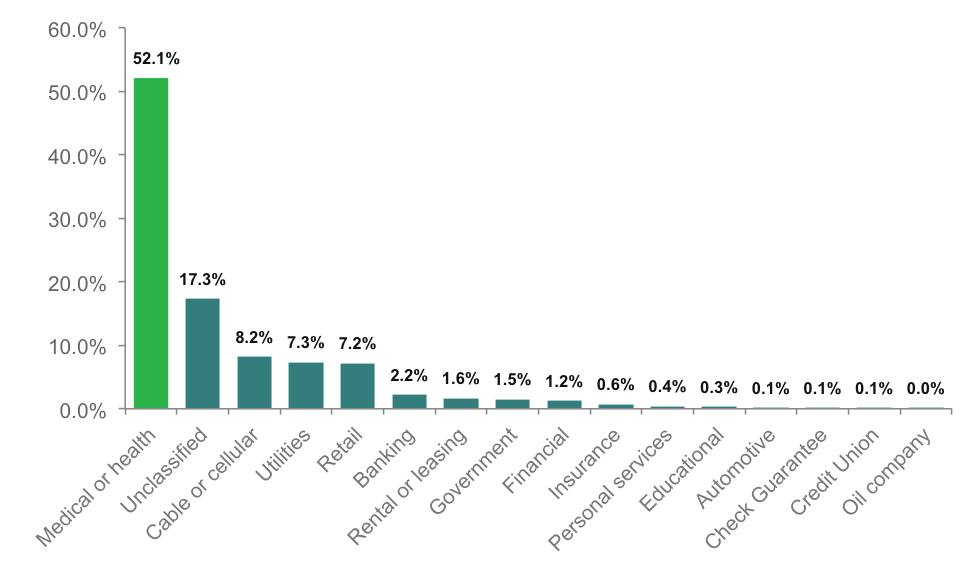
Medical debt on credit reports is a huge problem in the United States. Small medical debts cause large unnecessary harm to the credit rating of millions of Americans. The Consumer Financial Protection Bureau just issued a press release about the problems with medical debts on consumer credit reports. According to the CFPB, over 52% of all collection accounts on credit reports are medical debts. The tragedy is that many, if not most, of these delinquent accounts belong to people who can and do pay their bills. Even a single unpaid bill can be a negative item on your credit report for 7 years - even if later paid - and significantly impact your credit score. The scope of the problem is highlighted by the CFPB's graph showing the preponderance of medical accounts.
I receive a lot of calls from people who are surprised at medical debts showing up on their reports. Medical bills can be confusing, and they come in batches. It is easy for a bill to slide between the cracks, and collectors aren't always diligent about sending collection notices before reporting the debts. Also, consumers often are caught in the middle between their health care providers and their insurance companies. The providers often submit inadequate claims to the insurance companies, and the insurance companies often wrongfully delay or refuse payment.
How to get medical debts off your report
The key to getting these medical bills off your report is to become a letter-writing machine. When a provider or a collection agency puts a medical collection item on your credit report, if it is owed, you can pay the bill, BUT, pay it with conditions. Put in your letter that you are tendering the payment under the condition that they delete the tradeline on the credit report. (A tradeline is the term for the reporting of a single account on your credit report.) If appropriate, you can add in your letter that you are paying a disputed bill (and give the reason) or that it should not have been reported because you did not have the opportunity to pay it earlier. Sometimes it even makes sense to pay a bill that should be covered by insurance. It is penny-wise and pound-foolish to refuse to pay a small bill on principle when it can cost you thousands of dollars in extra credit costs. If you pay a bill the insurance company should have paid, you can always submit it to your insurance company to be reimbursed to you.
If you flat-out dispute owing the bill, you should send a letter VIA CERTIFIED MAIL (keeping a copy) to the medical provider or collector advising them that the bill is disputed and why. You should demand that the tradeline on the credit report be removed or replaced with a notice that the account is "disputed by the consumer". In a couple weeks you should check your credit reports, and if the disputed item is still listed (and not listed as disputed), you should send a dispute through the credit reporting agencies. That usually solves the problem, but if it doesn't, it is time to call a NACA (www.consumeradvocates.org) consumer lawyer because you may have a case for damages under the Fair Credit Reporting Act.
If you can get to the bill before it goes on the report . . .
The best way not to have a problem with medical bills on your credit report is to get to the bill before it is reported. That isn't always possible, but it is sometimes. These bills usually fit these categories: bills you can't pay, bills that are inaccurate or incomprehensible, and bills that are subject to insurance disputes and delays. If you can't pay the bill, it is important to make arrangements with the medical provider as early as possible and ask for payment terms and write-downs based on your ability to pay. Make sure any plan given is backed up in writing. If bills are inaccurate or incomprehensible, you need to advise the provider of the problem in writing and send a copy of your dispute to the insurance company. In most cases you are supposed to receive a letter from a collection agency advising you that you have 30 days to dispute the debt before further collection actions occur, including the action of putting it on your credit report. You need to take these letters seriously and send a dispute letter to the collection agency in writing, in a form that you can prove the agency received such as by fax with confirmation or certified mail. No disputed account should go on your credit report as an undisputed debt.
How to handle insurance problems
For the bills that the insurance company should pay but doesn't, you need to write the healthcare provider and advise them to withhold reporting while you work it out with the insurance company. If you contact your healthcare provider soon enough, the provider might not send the bill to collections in the first place. You need to write the insurance company and tell the insurer why the bill should be paid. If the insurance company says the provider did not submit the appropriate claim, you need to forward your insurance correspondence to the provider advising them to keep working on the claim. In some cases, if the healthcare provider is a member of a preferred provider network, the provider is contractually obligated to go through a dispute procedure with the insurance company rather than billing you directly. If your insurance company unreasonably withholds payments, you can and should file an administrative complaint. For private insurance that you acquire directly, you can complain to your state's insurance commission. For medicare and medicaid, there is a claims denial process, and a complaint process. For government-backed plans, you can also file a complaint with with the constituent services office of your congressional representative. For insurance that you receive through work (ERISA), the official complaint path goes through the United States Department of Labor Employee Benefits Security Administration, an agency that I have found is pretty close to useless. Another avenue for complaints is through your benefits representative at work, which is especially useful if you are in a union. Remember to make your complaint in writing and include documentation.
Negotiating discounts
Some bills you can negotiate a discount with the collection agency. When you bargain to a discounted amount, you should make it a specific term of the deal that in exchange for the payment, the collection agency agrees to delete the tradeline. When you submit the payment, you should include reference to the agreement to delete the tradeline in your cover letter accompanying the payment (keeping a copy, naturally). Often the collection agencies say they can't or aren't supposed to bargain to delete tradelines. They often do it anyway. There is no law saying any creditor has to report any debt. There might be a contractual agreement between a collector and a credit reporting agency not to settle debts in exchange for an agreement to delete the tradeline; but that's not your problem. Whenever you are negotiating with a collection agency, you need to convince them that the money you are giving them is money that they would never be able to get otherwise. If you are married, you should let them know that you are basing your offer on the income of the person who received the services and not the other spouse. If your entire income is social security, tell the collector that. Most collectors know they can't garnish social security, so they will usually be very reasonable with terms. I strongly discourage making payment plans with debt collectors. They rarely give you a good deal, and it just sets you up for hounding calls. Wait until you have a lump sum to offer; make your offer and stick to your guns.
HIPAA
Finally, there is the issue of HIPAA privacy. Some medical collection items on credit reports come from providers whose very names broadcast private information about your health. You can object to the inclusion of these tradelines on your credit reports with disputes to the credit reporting agencies.
As a side note, any time you dispute anything with the credit reporting agency, do it in writing, by letter, and keep a copy. If it is an important dispute that you don't want to have to do over, send it by certified mail. DO NOT use the agency's telephone or internet dispute mechanism because there is no good evidence to track your dispute.
The good news about health care collections on your credit report is that these are among the easiest credit reporting problems to solve if you are diligent with your letters. The bad news is that it takes a lot more time and hassle than it should. The new Consumer Financial Protection Bureau has recognized the problem, and it is working on regulations to make the process more fair. Until this regulatory response is in place, there is no substitute for your own efforts, backed up by a consumer lawyer when necessary. The CFPB is interested in hearing your story and handles complaints regarding the reporting of medical (and other) debt. You can contact the agency through this link.
I receive a lot of calls from people who are surprised at medical debts showing up on their reports. Medical bills can be confusing, and they come in batches. It is easy for a bill to slide between the cracks, and collectors aren't always diligent about sending collection notices before reporting the debts. Also, consumers often are caught in the middle between their health care providers and their insurance companies. The providers often submit inadequate claims to the insurance companies, and the insurance companies often wrongfully delay or refuse payment.
How to get medical debts off your report
The key to getting these medical bills off your report is to become a letter-writing machine. When a provider or a collection agency puts a medical collection item on your credit report, if it is owed, you can pay the bill, BUT, pay it with conditions. Put in your letter that you are tendering the payment under the condition that they delete the tradeline on the credit report. (A tradeline is the term for the reporting of a single account on your credit report.) If appropriate, you can add in your letter that you are paying a disputed bill (and give the reason) or that it should not have been reported because you did not have the opportunity to pay it earlier. Sometimes it even makes sense to pay a bill that should be covered by insurance. It is penny-wise and pound-foolish to refuse to pay a small bill on principle when it can cost you thousands of dollars in extra credit costs. If you pay a bill the insurance company should have paid, you can always submit it to your insurance company to be reimbursed to you.
If you flat-out dispute owing the bill, you should send a letter VIA CERTIFIED MAIL (keeping a copy) to the medical provider or collector advising them that the bill is disputed and why. You should demand that the tradeline on the credit report be removed or replaced with a notice that the account is "disputed by the consumer". In a couple weeks you should check your credit reports, and if the disputed item is still listed (and not listed as disputed), you should send a dispute through the credit reporting agencies. That usually solves the problem, but if it doesn't, it is time to call a NACA (www.consumeradvocates.org) consumer lawyer because you may have a case for damages under the Fair Credit Reporting Act.
If you can get to the bill before it goes on the report . . .
The best way not to have a problem with medical bills on your credit report is to get to the bill before it is reported. That isn't always possible, but it is sometimes. These bills usually fit these categories: bills you can't pay, bills that are inaccurate or incomprehensible, and bills that are subject to insurance disputes and delays. If you can't pay the bill, it is important to make arrangements with the medical provider as early as possible and ask for payment terms and write-downs based on your ability to pay. Make sure any plan given is backed up in writing. If bills are inaccurate or incomprehensible, you need to advise the provider of the problem in writing and send a copy of your dispute to the insurance company. In most cases you are supposed to receive a letter from a collection agency advising you that you have 30 days to dispute the debt before further collection actions occur, including the action of putting it on your credit report. You need to take these letters seriously and send a dispute letter to the collection agency in writing, in a form that you can prove the agency received such as by fax with confirmation or certified mail. No disputed account should go on your credit report as an undisputed debt.
How to handle insurance problems
For the bills that the insurance company should pay but doesn't, you need to write the healthcare provider and advise them to withhold reporting while you work it out with the insurance company. If you contact your healthcare provider soon enough, the provider might not send the bill to collections in the first place. You need to write the insurance company and tell the insurer why the bill should be paid. If the insurance company says the provider did not submit the appropriate claim, you need to forward your insurance correspondence to the provider advising them to keep working on the claim. In some cases, if the healthcare provider is a member of a preferred provider network, the provider is contractually obligated to go through a dispute procedure with the insurance company rather than billing you directly. If your insurance company unreasonably withholds payments, you can and should file an administrative complaint. For private insurance that you acquire directly, you can complain to your state's insurance commission. For medicare and medicaid, there is a claims denial process, and a complaint process. For government-backed plans, you can also file a complaint with with the constituent services office of your congressional representative. For insurance that you receive through work (ERISA), the official complaint path goes through the United States Department of Labor Employee Benefits Security Administration, an agency that I have found is pretty close to useless. Another avenue for complaints is through your benefits representative at work, which is especially useful if you are in a union. Remember to make your complaint in writing and include documentation.
Negotiating discounts
Some bills you can negotiate a discount with the collection agency. When you bargain to a discounted amount, you should make it a specific term of the deal that in exchange for the payment, the collection agency agrees to delete the tradeline. When you submit the payment, you should include reference to the agreement to delete the tradeline in your cover letter accompanying the payment (keeping a copy, naturally). Often the collection agencies say they can't or aren't supposed to bargain to delete tradelines. They often do it anyway. There is no law saying any creditor has to report any debt. There might be a contractual agreement between a collector and a credit reporting agency not to settle debts in exchange for an agreement to delete the tradeline; but that's not your problem. Whenever you are negotiating with a collection agency, you need to convince them that the money you are giving them is money that they would never be able to get otherwise. If you are married, you should let them know that you are basing your offer on the income of the person who received the services and not the other spouse. If your entire income is social security, tell the collector that. Most collectors know they can't garnish social security, so they will usually be very reasonable with terms. I strongly discourage making payment plans with debt collectors. They rarely give you a good deal, and it just sets you up for hounding calls. Wait until you have a lump sum to offer; make your offer and stick to your guns.
HIPAA
Finally, there is the issue of HIPAA privacy. Some medical collection items on credit reports come from providers whose very names broadcast private information about your health. You can object to the inclusion of these tradelines on your credit reports with disputes to the credit reporting agencies.
As a side note, any time you dispute anything with the credit reporting agency, do it in writing, by letter, and keep a copy. If it is an important dispute that you don't want to have to do over, send it by certified mail. DO NOT use the agency's telephone or internet dispute mechanism because there is no good evidence to track your dispute.
The good news about health care collections on your credit report is that these are among the easiest credit reporting problems to solve if you are diligent with your letters. The bad news is that it takes a lot more time and hassle than it should. The new Consumer Financial Protection Bureau has recognized the problem, and it is working on regulations to make the process more fair. Until this regulatory response is in place, there is no substitute for your own efforts, backed up by a consumer lawyer when necessary. The CFPB is interested in hearing your story and handles complaints regarding the reporting of medical (and other) debt. You can contact the agency through this link.
Subscribe to:
Posts (Atom)