If you have impaired credit and bought a car from one of the Andy Mohr Indianapolis-area dealerships, there is a good chance that your loan was placed with BAAM Financial Inc. BAAM Financial files a lot of lawsuits in Marion county. In representing a current client, I noticed that BAAM sues for unusually high deficiencies in what would be expected to be suits involving relatively low-priced vehicles. Let me explain.
My client purchased a 2005 Nissan Altima from Andy Mohr Nissan, Inc. in May 2013. She financed $10,398.65 on this car which had over 133,000 miles on it when she purchased it. That's not a good deal, in my opinion, but it's not illegal. The car was financed with BAAM Financial at 21% interest. Again, not a good deal in my opinion, but if you have credit issues you don't always have a choice. She made payments on it (not always on-time) until September 2016, when it was repossessed by BAAM. At the time it was repossessed, there was a listed balance on the loan of $8,100.54. It is this amount that BAAM sued her for plus costs, interest and attorney fees.
Note that the record this stage doesn't reflect that BAAM recovered any proceeds from the sale after repossession of the vehicle, or that BAAM applied proceeds to the loan balance sued upon. The law is clear that after repossessing a vehicle, the lender is supposed to dispose of the vehicle in a commercially reasonable way. It is possible that an old vehicle with mechanical problems doesn't have any commercial value. If that is the case, we are going to argue in this case that it is commercially unreasonable to repossess it in the first place, and if the lender repossesses the vehicle then finds out that it has no value, we are going to argue that commercial reasonableness requires that the lender needs to give the owner a chance to reclaim the vehicle.
I did a quick survey of what happened in five other BAAM Financial cases in Marion County Indiana. All of these cases went to default judgment, so the attorney fees are not likely too high. Each one of these cases reflect what are (in my opinion) high deficiency balances for subprime credit vehicles. I don't have records to tell me what caused the high deficiencies in these cases, but based on my experience with other cases, I would guess a mixture of high initial prices plus low prices obtained on disposition. Sometimes low prices at disposition are caused by commercially unreasonable sales, and sometimes not.
Case Number Judgment Amount
49D10-1604-CC-012616 $12,314,81
49D14-1601-CC-00113 $ 8,402.18 ("and forfeiture of 2004 F150")
49D04-1601-CC-000104 $13,266.49
49D01-1001-CC-00118 $13,370.49
49D01-1601-CC-00110 $ 8406.63
In summary, the amounts they are claiming after all credits were applied including after the sale of the car, looks a lot like what the car sold for originally, This isn't right, and judgments like these can be the financial deathblow to a struggling individual or family.
If you are currently being sued by Baam Financial, please talk to a lawyer. You need to make sure your rights are protected. You need to make sure that the vehicle was sold in a commerically reasonable way and that the proceeds of the sale were applied to your balance. If the finance company did not sell your vehicle in a commercially reasonable way (and getting an unusually low price at resale is often a result), you may be able to defend completely or partially against a lawsuit claiming a deficiency. In certain cases, you may be able to raise a claim for damages and attorney fees to be paid by the other side.
IF YOU HAVE BEEN SUED BY BAAM FINANCIAL, INC., EVEN IF YOUR CASE WENT TO JUDGMENT, I WILL REVIEW YOUR PAPERWORK AT NO CHARGE TO YOU. PLEASE CALL ME AT 317-662-4529 OR EMAIL ME AT HOFERLAWINDY@GMAIL.COM.
Showing posts with label the Spanish Inquisition. Show all posts
Showing posts with label the Spanish Inquisition. Show all posts
Friday, March 24, 2017

Wednesday, December 7, 2016
Some Comments on Common Ethical Violations Committed by Scamming Debt Settlement Florida Attorneys
If you are scammed by a Florida attorney or law firm, here is a complaint form to file with the Florida Bar. If you make a complaint, you should refer to at least one specific rule that the attorney has alleged to have broken. Here are the Florida Rules of Professional Conduct. Sorry for the bad formatting. I only have limited time to write this.
What allegations come into play? Take a look at this one: Rule 4-1.4 Communications.
RULE 4-1.4 COMMUNICATION
(a) Informing Client of Status of Representation. A lawyer shall:
(1) promptly inform the client of any decision or circumstance with respect to which
the client's informed consent, as defined in terminology, is required by these rules;
(2) reasonably consult with the client about the means by which the client's objectives
are to be accomplished;
(3) keep the client reasonably informed about the status of the matter;
(4) promptly comply with reasonable requests for information; and
(5) consult with the client about any relevant limitation on the lawyer's conduct when
the lawyer knows or reasonably should know that the client expects assistance not permitted
by the Rules of Professional Conduct or other law.
(b) Duty to Explain Matters to Client. A lawyer shall explain a matter to the extent
reasonably necessary to permit the client to make informed decisions regarding the
representation.
Take a look at Rule 4-1.5 Fees
RULE 4-1.5 FEES AND COSTS FOR LEGAL SERVICES
(a) Illegal, Prohibited, or Clearly Excessive Fees and Costs. An attorney shall not enter
into an agreement for, charge, or collect an illegal, prohibited, or clearly excessive fee or cost, or
a fee generated by employment that was obtained through advertising or solicitation not in
compliance with the Rules Regulating The Florida Bar. A fee or cost is clearly excessive when:
(1) after a review of the facts, a lawyer of ordinary prudence would be left with a
definite and firm conviction that the fee or the cost exceeds a reasonable fee or cost for
services provided to such a degree as to constitute clear overreaching or an unconscionable
demand by the attorney; or
(2) the fee or cost is sought or secured by the attorney by means of intentional
misrepresentation or fraud upon the client.
What I take from this is that any fee obtained by solicitation of telemarketers is an improper fee, period. The fees that I have seen ordinarily would leave a lawyer of ordinary prudence a definite conviction that the fees are clear overreaching or unconscionable.
Here's another one: Rule 4.3 Meritorious claims.
4-3. ADVOCATE
RULE 4-3.1 MERITORIOUS CLAIMS AND CONTENTIONS
A lawyer shall not bring or defend a proceeding, or assert or controvert an issue therein,
unless there is a basis in law and fact for doing so that is not frivolous, which includes a good
faith argument for an extension, modification, or reversal of existing law. A lawyer for the
defendant in a criminal proceeding, or the respondent in a proceeding that could result in
incarceration, may nevertheless so defend the proceeding as to require that every element of the
case be established.
- The Florida debt relief firms (if they do anything) dispute in mass the debts on the client's credit report. The attorneys have the duty to NOT dispute items that the client doesn't dispute in good faith. From what I have observed, disputes that aren't undertaken in good faith rarely survive the slightest challenge.
How about the lawyers duty to supervise nonlawyer assistants?
RULE 4-5.3 RESPONSIBILITIES REGARDING NONLAWYER ASSISTANTS
(a) Use of Titles by Nonlawyer Assistants. A person who uses the title of paralegal, legal
assistant, or other similar term when offering or providing services to the public must work for or
under the direction or supervision of a lawyer or law firm.
(b) Supervisory Responsibility. With respect to a nonlawyer employed or retained by or
associated with a lawyer or an authorized business entity as defined elsewhere in these Rules
Regulating The Florida Bar:
RRTFB – May 20, 2016
(1) a partner, and a lawyer who individually or together with other lawyers possesses
comparable managerial authority in a law firm, must make reasonable efforts to ensure that
the firm has in effect measures giving reasonable assurance that the person’s conduct is
compatible with the professional obligations of the lawyer;
(2) a lawyer having direct supervisory authority over the nonlawyer must make
reasonable efforts to ensure that the person’s conduct is compatible with the professional
obligations of the lawyer; and
(3) a lawyer is responsible for conduct of such a person that would be a violation of the
Rules of Professional Conduct if engaged in by a lawyer if the lawyer:
(A) orders or, with the knowledge of the specific conduct, ratifies the conduct
involved; or
(B) is a partner or has comparable managerial authority in the law firm in which
the person is employed, or has direct supervisory authority over the person, and knows
of the conduct at a time when its consequences can be avoided or mitigated but fails to
take reasonable remedial action.
(c) Ultimate Responsibility of Lawyer. Although paralegals or legal assistants may
perform the duties delegated to them by the lawyer without the presence or active involvement of
the lawyer, the lawyer must review and be responsible for the work product of the paralegals or
legal assistants.
In the "mill" debt relief firms, the "paralegals" often have no day-to-day contact with the attorneys at all.
Here's another biggie, Rule 4-5.5 Professional Independence of a lawyer. Under this rule a lawyer may not share fees with a nonlawyer (with small exceptions) and the lawyer may not work for a for-profit firm that is owned even in part by a nonlawyer. As far as I can tell, this rule is violated by every scam firm that I've seen. When the "support" firm receives the money and pays the lawyer, this rule is violated.
RULE 4-5.4 PROFESSIONAL INDEPENDENCE OF A LAWYER
(a) Sharing Fees with Nonlawyers. A lawyer or law firm shall not share legal fees with a
nonlawyer, except that:
(1) an agreement by a lawyer with the lawyer's firm, partner, or associate may provide
for the payment of money, over a reasonable period of time after the lawyer's death, to the
lawyer's estate or to 1 or more specified persons;
(2) a lawyer who undertakes to complete unfinished legal business of a deceased
lawyer may pay to the estate of the deceased lawyer that proportion of the total
compensation that fairly represents the services rendered by the deceased lawyer;
RRTFB – May 20, 2016
(3) a lawyer who purchases the practice of a deceased, disabled, or disappeared lawyer
may, in accordance with the provisions of rule 4-1.17, pay to the estate or other legally
authorized representative of that lawyer the agreed upon purchase price;
(4) bonuses may be paid to nonlawyer employees for work performed, and may be
based on their extraordinary efforts on a particular case or over a specified time period.
Bonus payments shall not be based on cases or clients brought to the lawyer or law firm by
the actions of the nonlawyer. A lawyer shall not provide a bonus payment that is calculated
as a percentage of legal fees received by the lawyer or law firm; and
(5) a lawyer may share court-awarded fees with a nonprofit, pro bono legal services
organization that employed, retained, or recommended employment of the lawyer in the
matter.
(b) Qualified Pension Plans. A lawyer or law firm may include nonlawyer employees in a
qualified pension, profit-sharing, or retirement plan, even though the lawyer's or law firm's
contribution to the plan is based in whole or in part on a profit-sharing arrangement.
(c) Partnership with Nonlawyer. A lawyer shall not form a partnership with a nonlawyer
if any of the activities of the partnership consist of the practice of law.
(d) Exercise of Independent Professional Judgment. A lawyer shall not permit a person
who recommends, employs, or pays the lawyer to render legal services for another to direct or
regulate the lawyer's professional judgment in rendering such legal services.
(e) Nonlawyer Ownership of Authorized Business Entity. A lawyer shall not practice
with or in the form of a business entity authorized to practice law for a profit if:
(1) a nonlawyer owns any interest therein, except that a fiduciary representative of the
estate of a lawyer may hold the stock or interest of the lawyer for a reasonable time during
administration; or
(2) a nonlawyer is a corporate director or officer thereof or occupies the position of
similar responsibility in any form of association other than a corporation; or
(3) a nonlawyer has the right to direct or control the professional judgment of a lawyer.
Comment
The provisions of this rule express traditional limitations on sharing fees. These limitations
are to protect the lawyer's professional independence of judgment. Where someone other than
the client pays the lawyer's fee or salary, or recommends employment of the lawyer, that
arrangement does not modify the lawyer's obligation to the client. As stated in subdivision (d),
such arrangements should not interfere with the lawyer's professional judgment.
This rule also expresses traditional limitations on permitting a third party to direct or
regulate the lawyer's professional judgment in rendering legal services to another. See also rule
RRTFB – May 20, 2016
4-1.8(f) (lawyer may accept compensation from a third party as long as there is no interference
with the lawyer's independent professional judgment and the client gives informed consent).
The prohibition against sharing legal fees with nonlawyer employees is not intended to
prohibit profit-sharing arrangements that are part of a qualified pension, profit-sharing, or retirement plan. Compensation plans, as opposed to retirement plans, may not be based on legal
fees.
Here's a tough one: Unlicensed Practice of Law. What exactly constitutes the "practice of law" is frustratingly vague. One thing we know from this rule though is that a lawyer who is admitted to practice in Florida but who represents a resident from another state must meet the ethical rules of the other state, and failure to meet those rules is a Florida violation too.
(a) Practice of Law. A lawyer may not practice law in a jurisdiction other than the
lawyer’s home state, in violation of the regulation of the legal profession in that jurisdiction, or
in violation of the regulation of the legal profession in the lawyer’s home state or assist another
in doing so.
Solicitation of clients Rule 4-4-18 - Very briefly the telemarketing arrangements are ethics violations.
RULE 4-7.18 DIRECT CONTACT WITH PROSPECTIVE CLIENTS
(a) Solicitation. Except as provided in subdivision (b) of this rule, a lawyer may not:
(1) solicit, or permit employees or agents of the lawyer to solicit on the lawyer's behalf,
professional employment from a prospective client with whom the lawyer has no family or
prior professional relationship, in person or otherwise, when a significant motive for the
lawyer's doing so is the lawyer's pecuniary gain. The term "solicit" includes contact in
person, by telephone, telegraph, or facsimile, or by other communication directed to a
specific recipient and includes any written form of communication, including any electronic
mail communication, directed to a specific recipient and not meeting the requirements of
subdivision (b) of this rule and rules 4-7.11 through 4-7.17 of these rules.
(2) enter into an agreement for, charge, or collect a fee for professional employment
obtained in violation of this rule.
Thursday, December 11, 2014
How to Handle Medical Debt Problems on Your Credit Report
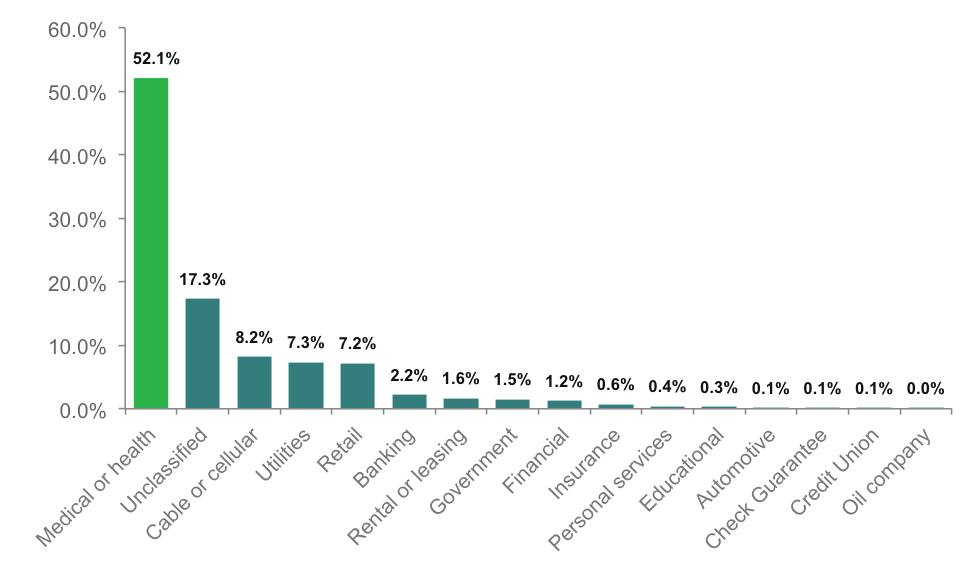
Medical debt on credit reports is a huge problem in the United States. Small medical debts cause large unnecessary harm to the credit rating of millions of Americans. The Consumer Financial Protection Bureau just issued a press release about the problems with medical debts on consumer credit reports. According to the CFPB, over 52% of all collection accounts on credit reports are medical debts. The tragedy is that many, if not most, of these delinquent accounts belong to people who can and do pay their bills. Even a single unpaid bill can be a negative item on your credit report for 7 years - even if later paid - and significantly impact your credit score. The scope of the problem is highlighted by the CFPB's graph showing the preponderance of medical accounts.
I receive a lot of calls from people who are surprised at medical debts showing up on their reports. Medical bills can be confusing, and they come in batches. It is easy for a bill to slide between the cracks, and collectors aren't always diligent about sending collection notices before reporting the debts. Also, consumers often are caught in the middle between their health care providers and their insurance companies. The providers often submit inadequate claims to the insurance companies, and the insurance companies often wrongfully delay or refuse payment.
How to get medical debts off your report
The key to getting these medical bills off your report is to become a letter-writing machine. When a provider or a collection agency puts a medical collection item on your credit report, if it is owed, you can pay the bill, BUT, pay it with conditions. Put in your letter that you are tendering the payment under the condition that they delete the tradeline on the credit report. (A tradeline is the term for the reporting of a single account on your credit report.) If appropriate, you can add in your letter that you are paying a disputed bill (and give the reason) or that it should not have been reported because you did not have the opportunity to pay it earlier. Sometimes it even makes sense to pay a bill that should be covered by insurance. It is penny-wise and pound-foolish to refuse to pay a small bill on principle when it can cost you thousands of dollars in extra credit costs. If you pay a bill the insurance company should have paid, you can always submit it to your insurance company to be reimbursed to you.
If you flat-out dispute owing the bill, you should send a letter VIA CERTIFIED MAIL (keeping a copy) to the medical provider or collector advising them that the bill is disputed and why. You should demand that the tradeline on the credit report be removed or replaced with a notice that the account is "disputed by the consumer". In a couple weeks you should check your credit reports, and if the disputed item is still listed (and not listed as disputed), you should send a dispute through the credit reporting agencies. That usually solves the problem, but if it doesn't, it is time to call a NACA (www.consumeradvocates.org) consumer lawyer because you may have a case for damages under the Fair Credit Reporting Act.
If you can get to the bill before it goes on the report . . .
The best way not to have a problem with medical bills on your credit report is to get to the bill before it is reported. That isn't always possible, but it is sometimes. These bills usually fit these categories: bills you can't pay, bills that are inaccurate or incomprehensible, and bills that are subject to insurance disputes and delays. If you can't pay the bill, it is important to make arrangements with the medical provider as early as possible and ask for payment terms and write-downs based on your ability to pay. Make sure any plan given is backed up in writing. If bills are inaccurate or incomprehensible, you need to advise the provider of the problem in writing and send a copy of your dispute to the insurance company. In most cases you are supposed to receive a letter from a collection agency advising you that you have 30 days to dispute the debt before further collection actions occur, including the action of putting it on your credit report. You need to take these letters seriously and send a dispute letter to the collection agency in writing, in a form that you can prove the agency received such as by fax with confirmation or certified mail. No disputed account should go on your credit report as an undisputed debt.
How to handle insurance problems
For the bills that the insurance company should pay but doesn't, you need to write the healthcare provider and advise them to withhold reporting while you work it out with the insurance company. If you contact your healthcare provider soon enough, the provider might not send the bill to collections in the first place. You need to write the insurance company and tell the insurer why the bill should be paid. If the insurance company says the provider did not submit the appropriate claim, you need to forward your insurance correspondence to the provider advising them to keep working on the claim. In some cases, if the healthcare provider is a member of a preferred provider network, the provider is contractually obligated to go through a dispute procedure with the insurance company rather than billing you directly. If your insurance company unreasonably withholds payments, you can and should file an administrative complaint. For private insurance that you acquire directly, you can complain to your state's insurance commission. For medicare and medicaid, there is a claims denial process, and a complaint process. For government-backed plans, you can also file a complaint with with the constituent services office of your congressional representative. For insurance that you receive through work (ERISA), the official complaint path goes through the United States Department of Labor Employee Benefits Security Administration, an agency that I have found is pretty close to useless. Another avenue for complaints is through your benefits representative at work, which is especially useful if you are in a union. Remember to make your complaint in writing and include documentation.
Negotiating discounts
Some bills you can negotiate a discount with the collection agency. When you bargain to a discounted amount, you should make it a specific term of the deal that in exchange for the payment, the collection agency agrees to delete the tradeline. When you submit the payment, you should include reference to the agreement to delete the tradeline in your cover letter accompanying the payment (keeping a copy, naturally). Often the collection agencies say they can't or aren't supposed to bargain to delete tradelines. They often do it anyway. There is no law saying any creditor has to report any debt. There might be a contractual agreement between a collector and a credit reporting agency not to settle debts in exchange for an agreement to delete the tradeline; but that's not your problem. Whenever you are negotiating with a collection agency, you need to convince them that the money you are giving them is money that they would never be able to get otherwise. If you are married, you should let them know that you are basing your offer on the income of the person who received the services and not the other spouse. If your entire income is social security, tell the collector that. Most collectors know they can't garnish social security, so they will usually be very reasonable with terms. I strongly discourage making payment plans with debt collectors. They rarely give you a good deal, and it just sets you up for hounding calls. Wait until you have a lump sum to offer; make your offer and stick to your guns.
HIPAA
Finally, there is the issue of HIPAA privacy. Some medical collection items on credit reports come from providers whose very names broadcast private information about your health. You can object to the inclusion of these tradelines on your credit reports with disputes to the credit reporting agencies.
As a side note, any time you dispute anything with the credit reporting agency, do it in writing, by letter, and keep a copy. If it is an important dispute that you don't want to have to do over, send it by certified mail. DO NOT use the agency's telephone or internet dispute mechanism because there is no good evidence to track your dispute.
The good news about health care collections on your credit report is that these are among the easiest credit reporting problems to solve if you are diligent with your letters. The bad news is that it takes a lot more time and hassle than it should. The new Consumer Financial Protection Bureau has recognized the problem, and it is working on regulations to make the process more fair. Until this regulatory response is in place, there is no substitute for your own efforts, backed up by a consumer lawyer when necessary. The CFPB is interested in hearing your story and handles complaints regarding the reporting of medical (and other) debt. You can contact the agency through this link.
I receive a lot of calls from people who are surprised at medical debts showing up on their reports. Medical bills can be confusing, and they come in batches. It is easy for a bill to slide between the cracks, and collectors aren't always diligent about sending collection notices before reporting the debts. Also, consumers often are caught in the middle between their health care providers and their insurance companies. The providers often submit inadequate claims to the insurance companies, and the insurance companies often wrongfully delay or refuse payment.
How to get medical debts off your report
The key to getting these medical bills off your report is to become a letter-writing machine. When a provider or a collection agency puts a medical collection item on your credit report, if it is owed, you can pay the bill, BUT, pay it with conditions. Put in your letter that you are tendering the payment under the condition that they delete the tradeline on the credit report. (A tradeline is the term for the reporting of a single account on your credit report.) If appropriate, you can add in your letter that you are paying a disputed bill (and give the reason) or that it should not have been reported because you did not have the opportunity to pay it earlier. Sometimes it even makes sense to pay a bill that should be covered by insurance. It is penny-wise and pound-foolish to refuse to pay a small bill on principle when it can cost you thousands of dollars in extra credit costs. If you pay a bill the insurance company should have paid, you can always submit it to your insurance company to be reimbursed to you.
If you flat-out dispute owing the bill, you should send a letter VIA CERTIFIED MAIL (keeping a copy) to the medical provider or collector advising them that the bill is disputed and why. You should demand that the tradeline on the credit report be removed or replaced with a notice that the account is "disputed by the consumer". In a couple weeks you should check your credit reports, and if the disputed item is still listed (and not listed as disputed), you should send a dispute through the credit reporting agencies. That usually solves the problem, but if it doesn't, it is time to call a NACA (www.consumeradvocates.org) consumer lawyer because you may have a case for damages under the Fair Credit Reporting Act.
If you can get to the bill before it goes on the report . . .
The best way not to have a problem with medical bills on your credit report is to get to the bill before it is reported. That isn't always possible, but it is sometimes. These bills usually fit these categories: bills you can't pay, bills that are inaccurate or incomprehensible, and bills that are subject to insurance disputes and delays. If you can't pay the bill, it is important to make arrangements with the medical provider as early as possible and ask for payment terms and write-downs based on your ability to pay. Make sure any plan given is backed up in writing. If bills are inaccurate or incomprehensible, you need to advise the provider of the problem in writing and send a copy of your dispute to the insurance company. In most cases you are supposed to receive a letter from a collection agency advising you that you have 30 days to dispute the debt before further collection actions occur, including the action of putting it on your credit report. You need to take these letters seriously and send a dispute letter to the collection agency in writing, in a form that you can prove the agency received such as by fax with confirmation or certified mail. No disputed account should go on your credit report as an undisputed debt.
How to handle insurance problems
For the bills that the insurance company should pay but doesn't, you need to write the healthcare provider and advise them to withhold reporting while you work it out with the insurance company. If you contact your healthcare provider soon enough, the provider might not send the bill to collections in the first place. You need to write the insurance company and tell the insurer why the bill should be paid. If the insurance company says the provider did not submit the appropriate claim, you need to forward your insurance correspondence to the provider advising them to keep working on the claim. In some cases, if the healthcare provider is a member of a preferred provider network, the provider is contractually obligated to go through a dispute procedure with the insurance company rather than billing you directly. If your insurance company unreasonably withholds payments, you can and should file an administrative complaint. For private insurance that you acquire directly, you can complain to your state's insurance commission. For medicare and medicaid, there is a claims denial process, and a complaint process. For government-backed plans, you can also file a complaint with with the constituent services office of your congressional representative. For insurance that you receive through work (ERISA), the official complaint path goes through the United States Department of Labor Employee Benefits Security Administration, an agency that I have found is pretty close to useless. Another avenue for complaints is through your benefits representative at work, which is especially useful if you are in a union. Remember to make your complaint in writing and include documentation.
Negotiating discounts
Some bills you can negotiate a discount with the collection agency. When you bargain to a discounted amount, you should make it a specific term of the deal that in exchange for the payment, the collection agency agrees to delete the tradeline. When you submit the payment, you should include reference to the agreement to delete the tradeline in your cover letter accompanying the payment (keeping a copy, naturally). Often the collection agencies say they can't or aren't supposed to bargain to delete tradelines. They often do it anyway. There is no law saying any creditor has to report any debt. There might be a contractual agreement between a collector and a credit reporting agency not to settle debts in exchange for an agreement to delete the tradeline; but that's not your problem. Whenever you are negotiating with a collection agency, you need to convince them that the money you are giving them is money that they would never be able to get otherwise. If you are married, you should let them know that you are basing your offer on the income of the person who received the services and not the other spouse. If your entire income is social security, tell the collector that. Most collectors know they can't garnish social security, so they will usually be very reasonable with terms. I strongly discourage making payment plans with debt collectors. They rarely give you a good deal, and it just sets you up for hounding calls. Wait until you have a lump sum to offer; make your offer and stick to your guns.
HIPAA
Finally, there is the issue of HIPAA privacy. Some medical collection items on credit reports come from providers whose very names broadcast private information about your health. You can object to the inclusion of these tradelines on your credit reports with disputes to the credit reporting agencies.
As a side note, any time you dispute anything with the credit reporting agency, do it in writing, by letter, and keep a copy. If it is an important dispute that you don't want to have to do over, send it by certified mail. DO NOT use the agency's telephone or internet dispute mechanism because there is no good evidence to track your dispute.
The good news about health care collections on your credit report is that these are among the easiest credit reporting problems to solve if you are diligent with your letters. The bad news is that it takes a lot more time and hassle than it should. The new Consumer Financial Protection Bureau has recognized the problem, and it is working on regulations to make the process more fair. Until this regulatory response is in place, there is no substitute for your own efforts, backed up by a consumer lawyer when necessary. The CFPB is interested in hearing your story and handles complaints regarding the reporting of medical (and other) debt. You can contact the agency through this link.
Subscribe to:
Posts (Atom)